
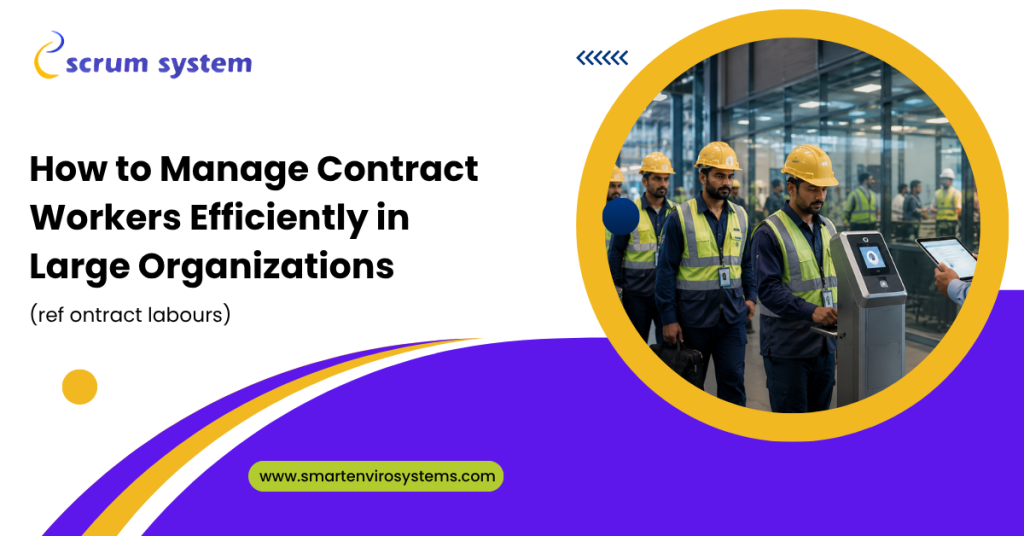

Managing 500+ contract workers across multiple sites—and still relying on Excel sheets? That’s not just inefficient, it’s risky.
In India, where industries like construction, manufacturing, and logistics heavily depend on contract labour, poor labour management can lead to compliance penalties, payroll chaos, and operational delays. According to a report by NITI Aayog, nearly 30% of India’s workforce is contractual or informal, making structured contract worker management more critical than ever.
In this blog, we’ll break down how large organizations can manage contract workers efficiently using proven strategies, modern tools like a labour management system, and best practices tailored for Indian businesses. We’ll also explore how solutions from Scrum Systems Pvt. Ltd are helping enterprises take full control of their workforce.
Let’s start with a clear roadmap.

1. What Is Contract Worker Management in Large Organizations?
Contract worker management refers to handling the complete lifecycle of contract employees—from onboarding and attendance tracking to compliance and payroll.
In large organizations, this becomes complex because:
- Multiple vendors are involved
- Workers are spread across locations
- Compliance requirements are strict
Without a structured labour management system, things quickly become difficult to manage.
2. Why Traditional Labour Management Fails at Scale
Traditional labour management methods often fail in large organizations due to a lack of structure and scalability.
No centralized data leads to inconsistencies across departments. Compliance risks increase when documentation is incomplete or outdated. Payroll processing becomes inefficient due to manual calculations, resulting in frequent errors. Most importantly, there is little to no visibility into workforce activity.
As management expert Peter Drucker said:
“You can’t manage what you can’t measure.”
Without a proper contract labour management system, even measuring workforce performance becomes challenging.
3. 6 Proven Strategies to Improve Contract Worker Management
1. Centralize Workforce Data
All worker-related data should be stored in one place. A strong labour management system creates a single source of truth, enabling better decision-making and reducing confusion.
2. Automate Attendance and Tracking
Manual attendance registers are outdated. Digital solutions allow real-time tracking of workers across locations. A modern contract labour management system ensures accurate and transparent attendance management.
3. Strengthen Compliance Management
Compliance is a major concern in India. A structured contract worker management approach helps automate documentation, track licenses, and ensure audit readiness.
4. Streamline Vendor Management
Managing multiple contractors without a system leads to inefficiencies. A labour management system helps monitor vendor performance, manage contracts, and maintain accountability.
5. Automate Payroll and Billing
Payroll errors can lead to disputes and dissatisfaction. A reliable contract labour management system ensures accurate wage calculations, timely payments, and transparent billing.
6. Use Data for Smarter Decisions
Modern labour management tools provide insights into workforce utilization, cost analysis, and productivity. According to Deloitte, organizations using workforce analytics experience up to 25% improvement in operational efficiency.

4. Role of a Labour Management System in Efficiency
A labour management system plays a crucial role in improving operational efficiency.
Instead of relying on fragmented systems, businesses can centralize operations, automate repetitive tasks, and gain real-time visibility into workforce activities. A well-implemented contract labour management system reduces manual effort and enables faster, more informed decision-making.
This is especially important for large organizations managing thousands of workers across multiple sites.
5. Key Features to Look for in a Contract Labour Management System
An effective contract labour management system should include the following features:
Digital onboarding to simplify worker registration and document verification.
Attendance management through biometric or mobile-based systems.
Compliance monitoring with automated alerts for legal requirements.
Vendor management to track contractor performance and agreements.
Payroll automation for accurate wage processing.
Analytics dashboards for real-time insights.
A comprehensive labour management system integrates all these features into a single platform.

6. Common Mistakes to Avoid
Organizations often face challenges due to avoidable mistakes.
Relying on manual systems limits scalability and efficiency. Ignoring compliance requirements can lead to penalties. Lack of transparency creates confusion among workers and vendors. Not investing in a modern contract labour management system prevents organizations from achieving operational efficiency.
Avoiding these mistakes is essential for effective contract worker management.
7. How Scrum Systems Pvt. Ltd Simplifies Workforce Management
Scrum Systems Pvt. Ltd offers advanced solutions designed to address the challenges of managing contract workers in large organizations.
Their contract labour management system is tailored to meet the needs of Indian industries, with a strong focus on compliance and scalability.
Key advantages include:
End-to-end contract worker management capabilities
Real-time workforce tracking and reporting
Strong compliance management aligned with Indian regulations
Seamless integration with existing systems
Scalable solutions suitable for large enterprises
Their labour management system helps businesses reduce manual processes, improve accuracy, and gain complete visibility over workforce operations.
8. Future Trends in Labour Management
The future of labour management is evolving with technology.
Artificial intelligence is enabling predictive workforce planning. Mobile-first solutions allow on-site management through smartphones. Cloud-based platforms ensure accessibility from anywhere. Integration with ERP and HRMS systems is creating seamless workflows across departments.
Modern contract worker management is becoming more proactive, data-driven, and efficient.
9. Final Thoughts
Managing contract workers efficiently in large organizations requires a structured approach, the right strategies, and advanced technology.
With the growing complexity of workforce operations in India, adopting a reliable labour management system is essential. A well-designed contract labour management system enables organizations to streamline operations, ensure compliance, and improve productivity.
Solutions from Scrum Systems Pvt. Ltd provide the tools needed to achieve efficient and scalable contract worker management in today’s competitive business environment.